I shall also be adding the new scans to the original post.
Old figures, old rules, old scenery, old articles, old reviews, and old wargamers. Not old school. Just old.
Tuesday, 4 April 2017
New scans of Wargaming in the Twin Cities
Saturday, 1 April 2017
Not Vintage, more Old School
A press release has landed at Vintage Towers announcing the
release of a new suite of “Old School” rules today.
Please see below:
The Society of Soggy Bottomed Wargamers are pleased to
announce the release of a new set of generic rules and the first two period
related supplements to enable you to refight the little know Cake Wars of the
late nineteenth century and earlier.
The generic rules set, Baking Powder, have been written by
JB Priestly.
The first two supplements are now available:
- Victorian Sponge, for the second the battles of d half of the 1800s, covering the golden age of baking and the Swiss role in them; scenarios include Pavlova and Baklava
- The World Turned Upside Down Cake, for the 17th Century (ECW – English Cake Wars)
Watch out for the forthcoming AWI (Awesome White Icing) variant
by Eclairer, and the Medieval and Dark Ages supplements Simnel and Scandi Toskvig
Godwinson.
Other periods in the pipeline for supplements include the
ACW (American Cake Wars) and RCW (Russian Cake Wars).
We are pleased also to announce a new associated range of
6mm figures by Mary berry od Bakeus Miniatures, but the rules will of course
also work with 10mm, 15mm, 20mm and 28mm. Add a little Hollywood to your Wargaming.
The rules feature:
- Special rules including for Baker rifle armed units; the rolling pinning of opponents; and individual acts of heroism contributing to the brownie points required for victory
- Different troop types
- Morale classes – raw, half baked, professional, overcooked
- Generals – fruit cake, fat rascal,
- Limited supply – when they’re scone they’re scone
Should be a cake walk.
Sunday, 8 January 2017
The Weigle has landed
I've had time for a quick first look at the Bruce Weigle 1870 booklet - not so much the rules as the historical information, aems and tactics stuff. This is excellent and all that I had hoped. Its flagged up a number of things I had thought would be significant but it was good to have them confirmed:
While this helps me with thoughts for FPW rules it leaves me considering Georland rules in a slightly different light. Though George Keef uses FPW figures Georland was more like Britain so the specific advantages of eiiher the French or the germans probably should not appear. For example, the British Army rifle of the period was the Snider Enfield, which did not enjoy the long range of the Chassepot.
Therefore I am thinking I might need two versions of any rules, one with the FPW factors and another "vanilla" one for Georland use, which is more generic.
I also want to take a look at a few other sets of rules to see if there is anything else I should take into account/borrow. next stop here is going to be the late nineteenth century rules in George Gush and Andrew Finch's A Guide to Wargaming.
- the long range fire zone of French Chassepots
- the superiority in materiel, training, and handling of the German artillery
- cavalry's real value limited to scouting, pursuit, and cavalry v cavalry action
- superior command and control enjoyed by the Germans
Therefore I am thinking I might need two versions of any rules, one with the FPW factors and another "vanilla" one for Georland use, which is more generic.
I also want to take a look at a few other sets of rules to see if there is anything else I should take into account/borrow. next stop here is going to be the late nineteenth century rules in George Gush and Andrew Finch's A Guide to Wargaming.
Friday, 6 January 2017
Looking forward to this...
... which arrived yesterday: Bruce Weigle's 1870 ruleset. It is for my twin tracked Franco Prussian War and Georland plans for this year. I have bought this for the historical information,OOBbs, scenarios etc it contains rather then the rules themselves.
I know what I want from my Georland rules (and I hope they will work just fine for FPW as well). I want something that will give a quick game and a reasonable period feel. For this reason I am looking to amend Command and Colors Napoleonics. I want to use this as the basis rather than Battle Cry as I think it will reflect European Warfare better. I will look to develop some simple amendments - I hope relatively few tweaks will be necessary, possibly infantry firing ranges and affect, French have more effective rifles, Germans have better artillery - can't believe it will only need that, so I have an interest at looking at other FPW rules to see if there are particular things to take into account. However, it seems unlikely to be that simple...
Ultimately I am after something stylised to fit in with the hex terrain, buildings, figures and basing I am intending to use.
Tuesday, 3 January 2017
Georland's enemies - Command
Prussian generals
Prussian and Bavarian standard bearers
I still have to decide what to do about flags. I want to be able to use the figures for Franco Prussian War as well as Georland. It is not so much an issue for the German troops but I need to decide whether to simply use French flags for Georland, or design a Georland flag and work out a way of alternating these - possibly by converting officer figures which can accommodate different flags and poles by drilling out a hand to receive them.
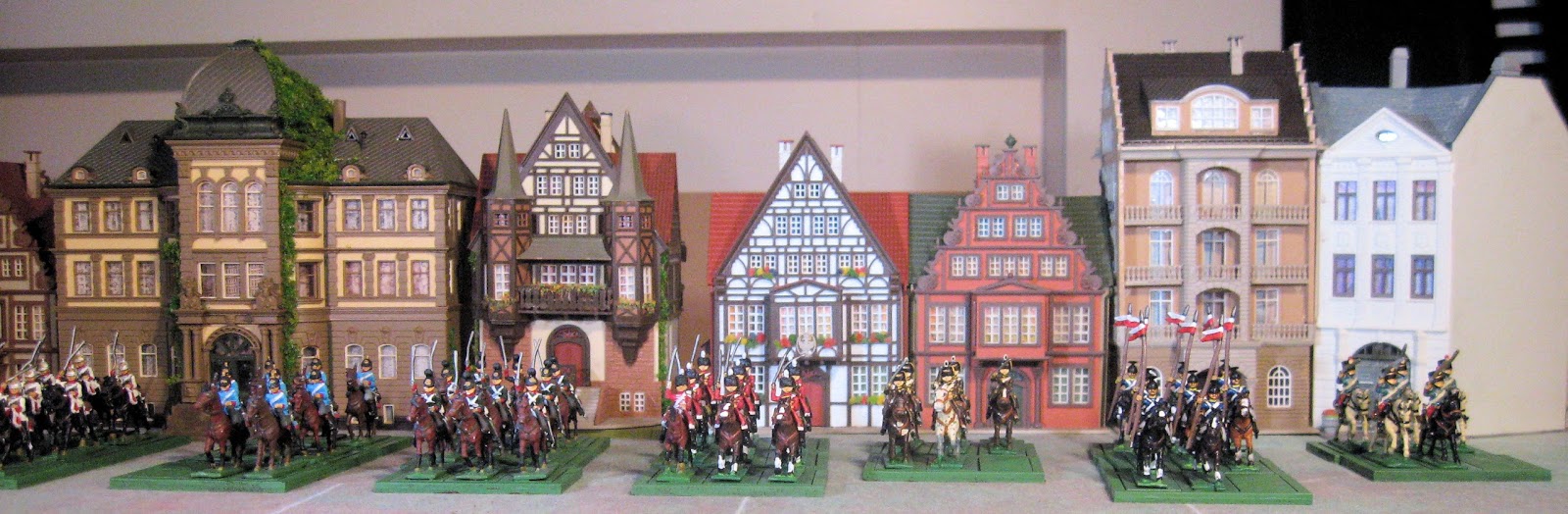
Georland's enemies - the cavalry
The S Range Franco Prussian War list included a number of German cavalry troop types which all can be used for the enemies of Georland. The various units available to me are:
Prussian Cuirassiers
Prussian Dragoons
Prussian Uhlans
Prussian Hussars
Bavarian Chevauleger
Georland's enemies - the infantry
Prussian Line Infantry
Silesian Riflemen
Bavarian Infantry
Saxon Infantry (apologies for the blurred photographs)
Wurttemberg Infantry
One of the good things about the Miniature Figurines Franco Prussian War Range was the presence of figures for various of the German States allied to Prussia, mainly for infantry but also including Bavarain cavalry and Wurttemberg artillery. These national contingents give some flexibility when representing the enmies of Georland.
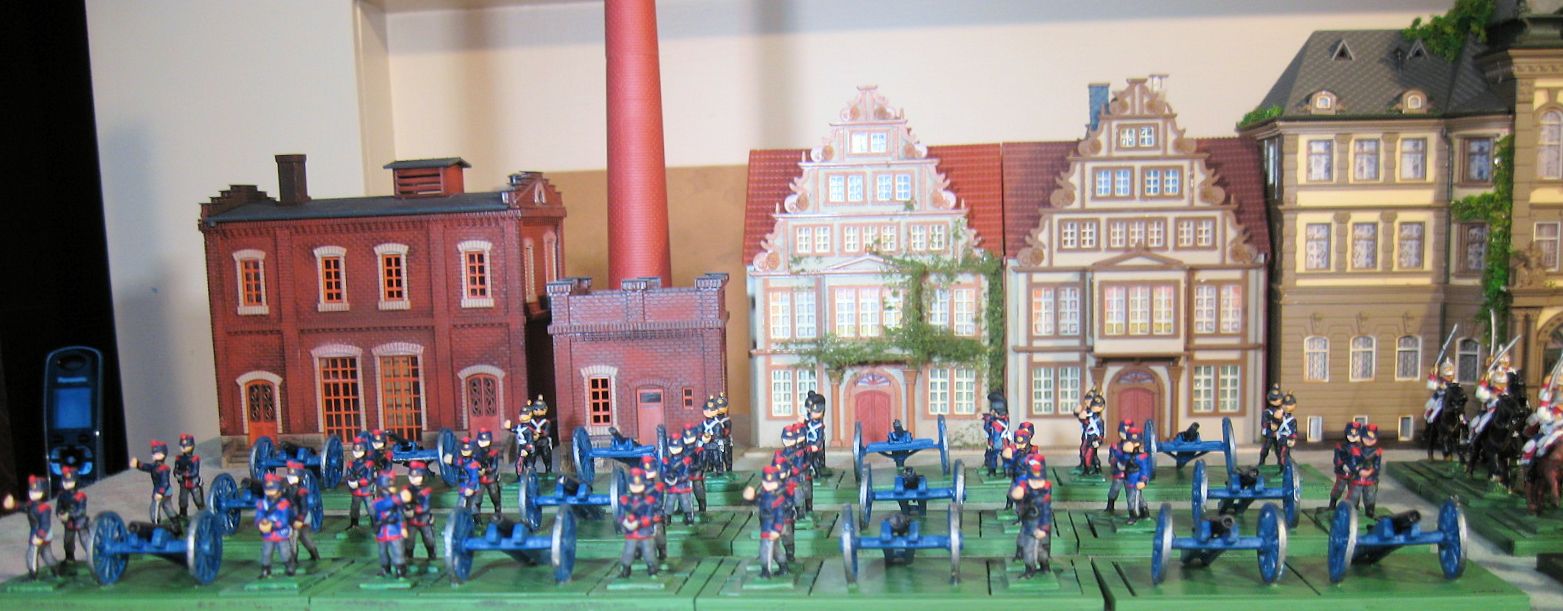
Georland's enemies - the artillery
Artillery pieces are by B&B and RAFM. The B&B Krupp gins have split trails, which I don't think are accurate, but I haven't been able to confirm this.
I acquired an Ebay lot of about 25 Wurttemberg gunners hence the over representation of their artillery arm - the first two rows of guns (and first four rows of gunners) in the picture above. In fact the Wurttembergers were the only German in the FPW range.
Prussian and Bavarian gun crews (Bavarians the middle of the three crews). These figures are conversions now available from John Cunningham. Most of the guns in this photo are RAFM. They have single trail carriages but the moulds are obviously well past their prime, with parts missing.
Sunday, 1 January 2017
The Georland Army - High Command
Army Commander - so this will be the famous General Mercury. I am still thinking what to do His Imperial Majesty - possibly the same figure with a fancier paint job, and a larger oval base including escort and ADC.
Mercury with Divisional and Brigade Commanders
The Georland Army - Cavalry
I have been painting up and organising my various S Range Franco Prussian War figures, along with some Crimean figures which jointly form my Second Empire/Red Trouser French forces.
These are partly for FPW gaming but also for my intention to refight some of George Keef's campaigns from the 1870s and 80s as detailed in the History of Georland blog.
Figures are individually based on MDF (20x20mm for foot and 20x40mm for mounted) and then placed in movement trays accommodating six infantry in two ranks or three cavalrymen abreast. An infantry battalion is four companies of six figures and a squadron of cavalry two troops of three figures each.
Cpmmanders and some infantry unit command stands us circular bases of different sizes, showing different levels of command.
I'm going to photograph and post these over the next few days but here are the French (and Georland) cavalry for starters.
Spahis
Chasseurs d'Afrique
Dragoons
Cuirassiers
Commanders (including the famous General Mercury)
Labels:
Crimean War,
Franco Prussian War,
Georland,
S Range
The Georland Army - Artillery
French Crimean War Horse Artillery
FPW gunners
Not the best photos I'm afraid, I will try to redo them some time. I also had difficulty with the straighten tool in photoshop for these two pictures.
They do display the basing and movement tray system I am using.
The guns are from the B&B Wargames 20mm FPW range. There are two different type of field piece, 4 pdr and 12 pdr.
There are also an S Range Mitrailleuse, two S Range Gatlings (which I may or may not use), and an Imperial Modellbau Mitrailleuse, available from the Hagen.de shop.
I am currently awaiting more gunners of both sorts.
Drout's Artillery were one of the key units of the Georland Army and I suspect this will be represented by the Crimean Horse Artillery figures.
Labels:
Crimean War,
Franco Prussian War,
S Range,
Second Empire
The Georland Army - Infantry
My Georland Army will use Minifigs S Range French figures, mainly Franco Prussian War but augmented by some Crimean War red trouser era (Second Empire). This seems appropriate as George Alfred Keef's soldiers were Franco Prussian War types bought in bilk in the 1870's, although his figures were German-made 40mm demi-rondes.
So we will start with these Crimean figures:
Line Infantry
Imperial Guard Infantry
Zouaves and Turcos (the same figures, just different paint jobs)
Then the Franco Prussian War Infantry units:
Imperial Guard
Chasseurs a Pied
Zouaves
Turcos (the same figure with a different paint job)
Naval Infantry
Voltigeurs
Line Infantry (three battalions)
I still have to further research the Georland Order of Battle and work out which units these figures can represent.
Labels:
Crimean War,
Franco Prussian War,
Georland,
S Range
Subscribe to:
Posts (Atom)