Monday, 27 August 2018

Ronald Welch


The books of your youth are rather special. I was very taken with the historical novels of Ronald Welch about the Carey family and their soldiering through the ages. The first two I remember reading (and then re-reading many times) were Knight Crusader (set in the Third Crusade) and For the King (English Civil War). The front end papers had a family tree of the Careys, showing how they related to the various bools of the series, going through to WW1 (Tank Commander). I borrowed all those I could find (repeatedly) from my local library, and I think they were where my lifetime interests in history and military history either started or were confirmed. They certainly sparked my interest in the English Civil War, which even survived A levels.

They bore the unmistakable signs of extensive historical research, which is no surprise as their author, Ronald Felton (1909-1982, was history teacher who served as a tank commander in the Second World War and took his pen name from his wartime regiment, the Royal Welch Fusiliers.

They have been out of print for a long time and second hand were expensive and hard to track down. In the last five years Slightly Foxed have been reissuing them in a limited edition of 2,000 copies and last week I bit the bullet and bought a complete set. Expensive but worth it I think.

The complete list of the Carey Novels (in chronological order) is:

Knight Crusader
Bowmen of Crecy
Sun of York
The Galleon
The Hawk
For the King
Captain of Dragoons
Mohawk Valley
Escape from France
Captain of Foot
Nicholas Carey
Ensign Carey
Tank Commander

There is also an unpublished novella, the Road to Waterloo.

Other non-Carey novels included The Gauntlet and Zulu Warrior.

I've also had that particular thrill of now finding titles I had never seen at the time - last summer I found a Dalziel and Pascoe novel by Reginald Hill I had completely missed on publication.

I have the same feeling about these novels as I did when I discovered a few years ago that the TV series The Flaxton Boys, which I watched about the same time, had been in part written by Don Houghton, of At the Colonel's Table fame. Now I've thought about it again, I've just ordered the DVD from Amazon.

I'm sure some of you out there probably read these once upon a time. For the rest of you there is an undiscovered treat if you want to look into them. Written for children yes, but with a depth of historical background which still makes them satisfying adult reading.

They deserve to be better known.


Sunday, 26 August 2018

Not exactly vintage but...


...can anyone help me identify the manufacturer of this range, and/or who sells them now?

They are 20mm figures and part of a larger range of Arabs and French Foreign Legion. I bought these as samples a few years ago from a seller on eBay, but when I tried to buy more they had a complicated system for ordering  from their listing which I couldn't get to work for me; when I tried to contact them to order more figures direct there was no response. I haven't seen them listed again since and I have no information about that original order.

My only other memory is that I think they had various other ranges, and described these as an old range.

Any helpful suggestions via comments gratefully received.

Wednesday, 8 August 2018

Georland - a bit of a rethink?


I realise it's been a very long time since I posted anything over on the Georland blog and the project has been firmly on the back burner for a while.

This has partly been because I had achieved that mythical state of "having finished" the S Range Franco Prussian armies I had intended to use for the project, and started on other things: then acquired quite a large number of additional S Range figures of various German states infantry and cavalry. This made me feel painting them up was another large project which I wasn't yet up to the challenge of starting.

So while I had (and still have) an intention to refight some of the Georland battles on the tabletop, it also dawned on me over quite a long period of time that maybe I didn't want to use the Franco Prussian figures after all for this. I am perfectly happy to have two good sized Franco Prussian War armies and use them just for that. I was influenced by this picture, a watercolour by George Keef in the Journal, entitled the Battle of Emburg (or Enburg, depending on your reading of the script)  dated 8 August 1873. A larger version of the picture appears at the bottom of the home page of the Georland blog.

The lines of red coated troops have brought me back to my original intention, which was to use my S Range Crimean armies, to achieve a similar look. I think the FPW option came about because George Keef's original soldiers were mainly semi round FPW figures, with the French providing the Georlan forces.

So while the Franco Prussian Germans will prove useful for some of the wars of the later Epochs, I am now thinking I might go back to British Crimean War figures for Georland, to achieve a similar aesthetic to this picture.

If I do choose to go this way I won't regard the FPW project as a sidetrack, as it stands on its own and without the interest in terms of Georland I doubt I would have got anywhere near as far with painting the figures, as I would have got distracted into something else. (And in fact while I have some further S Range Crimean Highlanders somewhere in the painting crew I also have some Hinton Hunt and Douglas British Crimean figures which will probably get attention before they do). I am unlikely to be happy using the Hinton Hunt and Douglas figures alongside S range ones, but will have to see. Also I have some very nicely painted Hinton Hunt Crimean Russian infantry somewhere which I must dig out sometime.

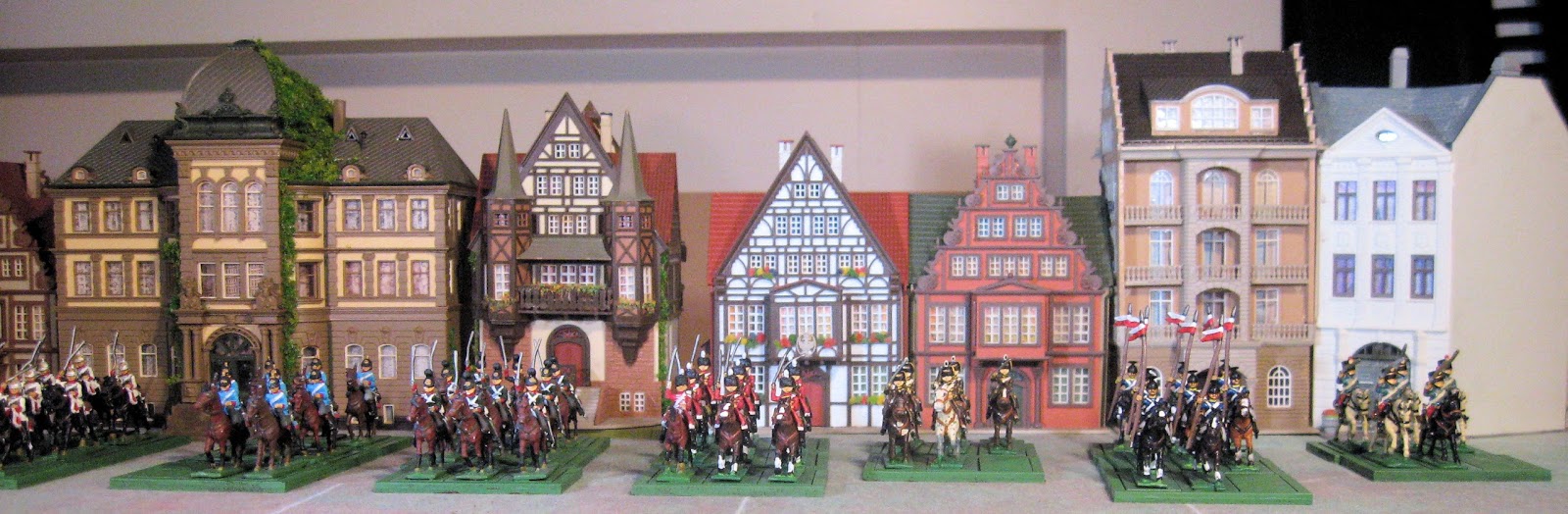
I also greatly enjoyed  assembling my collection of buildings from German railway scenery manufacturers, so I would also need to give some thought to whether to use these or the Russian style (and slightly larger scale) buildings I have instead.

It is all a bit hypothetical as I doubt anything will happen any time soon. I realise I need to do a fair bit of research for the Orders of Battle for any engagements I might want to refight, as although there is information in the scans I have of the last section of the Journal, they can be hard to decipher and may have lost some of their content to the scanner's margin settings.

But I think some good problems to have.

(I have also posted this update on the Georland blog).

Sunday, 17 June 2018

Hinchliffe 20mm Equipment Range


In the comments on a recent post about French line artillery on Stryker's Hinton Hunt Vintage Wargames Figures blog there has been a little discussion about the Hinchliffe 20mm equipment range. These were generally reckoned the best 20mm equipment available, significantly better than Hinton Hunt guns and limbers, and with a slightly bigger range. 

Although the moulds were lost a long time ago I was surprised how little known they appear to be even among aficionados of vintage 20mm figures so I am posting the listing and some photo from the 1972 Hinchliffe catalogue. They certainly deserve to be better known.

Below are two photos of a Peter Gilder French Old Guard Artillery crew with a Hinchliffe 20mm French 12 pdr gun.(These are Hinton Hunt figures which were originally owned by Peter Gilder).


A British 10" howitzer, suitable for both Napoleonic and Crimean Waes


British Colonial Elephant team and 40 pdr gun


4 sets, with the 40 pdr gun versions on each side and 2 sets with the 6.3" Howitzer in the middle. (I know the tubes of the 40 pdrs are in firing rather than travelling position but I didn't want to have any of the guns only in the travelling position This set was the first metal figures I ever saw, in a hardware shop in Durham in the early 1970s. I can't remember the cost but it was astronomical when Airfix figures had been 2/11 a box. More than 40 years later and with the help of eBay and others I now have about 12 sets of them, which may be overcompensating.

And finally a pair of British Colonial Baggage wagons. These came without horse teams or divers/crews, so these have been completed with S Range draught horses and Jacklex drivers.

Friday, 19 January 2018

FPW Staff


One of the issues with the S Range Franco Prussians is the fact that there is only one General figure per side and this doesn't help with the variety of command elements.

Before Christmas I bought a large bunch of Germans from the FPW range. Among them were some of the command figures from B&B Miniatures 20mm range. These are quite small on their scrubby horses but have their horse furniture cast on the figure, so if you put them on the larger S Range horses they match up well.

I then went and ordered some French staff to match. The Prussian picture above (top) includes S Range figures as well so you can see how well they go together.

The building is another pre-Christmas acquisition, a German HO railway building to serve as a divisional, corps or army headquarters.

Tuesday, 16 January 2018

S Range Field Defences


Following my last post when I unexpectedly acquired these along with an S Range Napoleonic Austrian Army I thought they would be an appropriate post here.

If you studied your S Range catalogue carefully you could find a section called Miscellaneous, which contained goodies including camp followers, generals of different periods, pack horses and oxen, and Napoleon sat at a table.

The above are FSD 1s and FSD 2s, Horse and Musket Period Field Defences, Chevaux de Frise - 60mm length at the back of the photograph - and Stakes - 55mm at the front.

These are heavy lumps of metal and I had never seen them before.

FSD 3s and 4s were gabions and fascines.

Sunday, 12 November 2017

Bellona Manuals of Military Field Works of the 18th & 19th Centuries and of the 20th Century


I posted about Bill Holmes here back in 2010. You may remember the Deltorama adverts from Wargamer's Newsletter, or his Journal (pre-blogs) which was featured in Don Featherstone's Solo Wargaming.

I have had the first of these two booklets for some time but just bought the second from eBay, so I thought they were worth a post. His drawing style was very distinctive and I thought they also deserved a post as an example of Bellona publications. If you want to see three examples of 19th Century military bridging or three types of 20th Century latrines these are the books for you. Cost on publication was 5/-.

Monday, 30 October 2017

Sunday, 17 September 2017

Grove and Benoy Highlanders


Something of a surprise -  I recently spotted four lots of unidentified Highlanders on ebay. as sole bidder on all four lots I was glad when they arrived and confirmed my conviction that these were in fact more Grove & Benoy figures. I wasn't aware of there being any Highlanders before and they include sergeants, officers, ensigns (missing flags), a band (some missing instruments), drummers and pipers, and masses of marching rank and file. I will try to get better photos when the light improves.

You can access earlier posts on Grove and Benoy here.

.


Sunday, 18 June 2017

Eugene's IV Corps in Minifigs S Range figures


As no stranger to grand statement projects myself, I was delighted to receive Alan M's photographs of his Eugene's IV Corps using S Range miniatures. Particularly pleasing not to see wall to wall Old Guard and good honest Chasseurs a Cheval of the Line.

These are just taster hotos - the full 40 (yes forty) can be seen here on the Lone S Ranger blog.

Monday, 12 June 2017

Hinton Hunt Original Painting Instructions Transcribed


Over on my Hinton Hunter blog I have posted on my project to transcribe all the original Hinton Hunt painting instructions I could find for their 20mm Napoleonic range.

Following the link to the blog post will provide more information and how to get hold of the transcripts if you want them.

Monday, 5 June 2017

WANTED: Minifigs 15mm SYW strips

15mm are really not my thing so I was unable to help when I was asked by someone looking for 1st generation Minifigs 15mm tricorn SYW cavalry. I did however say I would post his request here. If anyone may have some of these figures available, please contact me through the comments section and I will put you in touch with each other.

Wednesday, 10 May 2017

Battle of the Coral Sea Competition -- no prize!

Can anyone say what is unusual about these pictures of the Battle of the Coral Sea from Life magazine May 25th 1942?

More photos when someone comes up with the answer.


Tuesday, 4 April 2017

New scans of Wargaming in the Twin Cities

 As this is the second most popular post on Vintage Wargaming, I thought it was about time I posted better scans of this rather tatty newspaper article frrom the Minneapolis Tribune Picture Supplement 17th April 1966.


I shall also be adding the new scans to the original post.

Saturday, 1 April 2017

Not Vintage, more Old School

A press release has landed at Vintage Towers announcing the release of a new suite of “Old School” rules today.

Please see below:


The Society of Soggy Bottomed Wargamers are pleased to announce the release of a new set of generic rules and the first two period related supplements to enable you to refight the little know Cake Wars of the late nineteenth century and earlier.

The generic rules set, Baking Powder, have been written by JB Priestly.


The first two supplements are now available:

  • Victorian Sponge, for the second the battles of d half of the 1800s, covering the golden age of baking and the Swiss role in them; scenarios include Pavlova and Baklava
  • The World Turned Upside Down Cake, for the 17th Century (ECW – English Cake Wars)


Watch out for the forthcoming AWI (Awesome White Icing) variant by Eclairer, and the Medieval and Dark Ages supplements Simnel and Scandi Toskvig Godwinson.

Other periods in the pipeline for supplements include the ACW (American Cake Wars) and RCW (Russian Cake Wars).

We are pleased also to announce a new associated range of 6mm figures by Mary berry od Bakeus Miniatures, but the rules will of course also work with 10mm, 15mm, 20mm and 28mm. Add a little Hollywood to your Wargaming.

The rules feature:
  1. Special rules including for Baker rifle armed units; the rolling pinning of opponents; and individual acts of heroism contributing to the brownie points required for victory
  2. Different troop types
  3. Morale classes – raw, half baked, professional, overcooked
  4. Generals – fruit cake, fat rascal,
  5. Limited supply – when they’re scone they’re scone


Should be a cake walk.

Sunday, 8 January 2017

The Weigle has landed

I've had time for a quick first look at the Bruce Weigle 1870 booklet - not so much the rules as the historical information, aems and tactics stuff. This is excellent and all that I had hoped. Its flagged up a number of things I had thought would be significant but it was good to have them confirmed:


  • the long range fire zone of French Chassepots
  • the superiority in materiel, training, and handling of the German artillery
  • cavalry's real value limited to scouting, pursuit, and cavalry v cavalry action
  • superior command and control enjoyed by the Germans


While this helps me with thoughts for FPW rules it leaves me considering Georland rules in a slightly different light. Though George Keef uses FPW figures Georland was more like Britain so the specific advantages of eiiher the French or the germans probably should not appear. For example, the British Army rifle of the period was the Snider Enfield, which did not enjoy the long range of the Chassepot.

Therefore I am thinking I might need two versions of any rules, one with the FPW factors and another "vanilla" one for Georland use, which is more generic.

I also want to take a look at a few other sets of rules to see if there is anything else I should take into account/borrow. next stop here is going to be the late nineteenth century rules in George Gush and Andrew Finch's A Guide to Wargaming.


Friday, 6 January 2017

Looking forward to this...


... which arrived yesterday: Bruce Weigle's 1870 ruleset. It is for my twin tracked Franco Prussian War and Georland plans for this year. I have bought this for the historical information,OOBbs, scenarios etc it contains rather then the rules themselves.

I know what I want from my Georland rules (and I hope they will work just fine for FPW as well). I want something that will give a quick game and a reasonable period feel. For this reason I am looking to amend Command and Colors Napoleonics. I want to use this as the basis rather than Battle Cry as I think it will reflect European Warfare better. I will look to develop some simple amendments - I hope relatively few tweaks will be necessary, possibly infantry firing ranges and affect, French have more effective rifles, Germans have better artillery - can't believe it will only need that, so I have an interest at looking at other FPW rules to see if there are particular things to take into account. However, it seems unlikely to be that simple...

Ultimately I am after something stylised to fit in with the hex terrain, buildings, figures and basing I am intending to use.

Tuesday, 3 January 2017

Georland's enemies - Command


Prussian generals


Prussian and Bavarian standard bearers

I still have to decide what to do about flags. I want to be able to use the figures for Franco Prussian War as well as Georland. It is not so much an issue for the German troops but I need to decide whether to simply use French flags for Georland, or design a Georland flag  and work out a way of alternating these - possibly by converting officer figures which can accommodate different flags and poles by drilling out a hand to receive them.

Georland's enemies - the cavalry


The S Range Franco Prussian War list included a number of German cavalry troop types which all can be used for the enemies of Georland. The various units available to me are:


Prussian Cuirassiers


Prussian Dragoons


Prussian Uhlans


Prussian Hussars


Bavarian Chevauleger

Georland's enemies - the infantry


Prussian Line Infantry


Silesian Riflemen


Bavarian Infantry


Saxon Infantry (apologies for the blurred photographs)


Wurttemberg Infantry


One of the good things about the Miniature Figurines Franco Prussian War Range was the presence of figures for various of the German States allied to Prussia, mainly for infantry but also including Bavarain cavalry and Wurttemberg artillery. These national contingents give some flexibility when representing the enmies of Georland.