Over on the Lone S Ranger blog I have posted some information on these figures. There are a number of figures which I have not been able definitely to identify, and there are also a fair number for which I have no pictures. If you know this range quite well, or maybe even have figures from it, I would be grateful if you e a look at the blog and pass on any further identification help you may be able to give.
These posts can be found here.
Saturday, 16 April 2011

Friday, 1 April 2011
HG Wells outgunned
HG Wells famously used matchstick-firing artillery models in his Little Wars, but he would have been seriously outgunned by Franz Stollberg, unearthed by Don Featherstone in Wargamer's Newsletter 101, of August 1970.


Thursday, 17 March 2011
Operation Warboard


One of the early books which seems to get unjustly neglected is Gavin Lyall's Operation Warboard (though it does have a number of strong adherents). Lyall was better known as a thriller writer, and was married to the journalist Katherine Whitehorn.
I wonder if anyone out there remembers making the machine gun grid for this game...
I am fortunate that my copy of the book is the original hardback (though I have a sneaking suspicion I may have a paperback copy somewhere too).
The pictures show the front and back covers of the hardback (published Adam and Charles Black 1976) and an ad for the Pan paberback from Military Modelling incorporating Battle for wargamers from November 1978.
Thursday, 10 March 2011
Milestone: 100,000 hits
I've been keeping an eye on the blog counter this evening and it has just gone past 100,000 hits. Thanks to everyone who visits, or comments.
Tuesday, 8 March 2011
The old and the new: Command&Colors: Napoleonics with vintage figures
I'm not really sure which blog to put this on, so I'm posting it here and on the Hinton Hunter.
This weekend saw a visit almost to the Kingdom of Fife, to join Tony of Prometheus in Aspic in test playing Richard Borg's new Command&Colors Napoleonics with vintage figures - Tony's Peninsular French against my Hinton Hunt and Der Kriegspieler Russians and Prussians.
An emergency visit to my local timber merchants on Thursday morning equipped me with around 40 120mm square sabots made from 4mm MDF (£6 the lot); with these and three trays of figure we were good to go.
Others have been playing C&C: Napoleonics with figures (see Conrad Kinch's recent excursion on Joy and Forgetfulness) but the combination of Tony's hex based set up, and the vintage figures we used, made for an interesting spectacle. We played three games - the Rolica first French position and second French position scenarios to a conclusion, all within one day including lunch out and an Indian takeaway. The Russians and Prussians stood in for the British in these scenarios, using French (rather than British) unit characteristics.
The game worked well, was easy to pick up, thoroughly enjoyable and somehow seemed appropriate to the figures. Along with Tony, I wouldn't want it to be the only Napoleonic rules I ever played, but it was thoroughly enjoyable and refreshing to get three games played right through in such a short time. Plenty of surprises to keep you on the toes, and of course Tony had done all the hard work of customising the dice and cards from the game.
Here are two slideshows, one for each of the scenarios (we played the second one twice.
Battle of Rolica: French first position
Battle of Rolica: French second position
This weekend saw a visit almost to the Kingdom of Fife, to join Tony of Prometheus in Aspic in test playing Richard Borg's new Command&Colors Napoleonics with vintage figures - Tony's Peninsular French against my Hinton Hunt and Der Kriegspieler Russians and Prussians.
An emergency visit to my local timber merchants on Thursday morning equipped me with around 40 120mm square sabots made from 4mm MDF (£6 the lot); with these and three trays of figure we were good to go.
Others have been playing C&C: Napoleonics with figures (see Conrad Kinch's recent excursion on Joy and Forgetfulness) but the combination of Tony's hex based set up, and the vintage figures we used, made for an interesting spectacle. We played three games - the Rolica first French position and second French position scenarios to a conclusion, all within one day including lunch out and an Indian takeaway. The Russians and Prussians stood in for the British in these scenarios, using French (rather than British) unit characteristics.
The game worked well, was easy to pick up, thoroughly enjoyable and somehow seemed appropriate to the figures. Along with Tony, I wouldn't want it to be the only Napoleonic rules I ever played, but it was thoroughly enjoyable and refreshing to get three games played right through in such a short time. Plenty of surprises to keep you on the toes, and of course Tony had done all the hard work of customising the dice and cards from the game.
Here are two slideshows, one for each of the scenarios (we played the second one twice.
Battle of Rolica: French first position
Battle of Rolica: French second position
Saturday, 26 February 2011

Monday, 14 February 2011
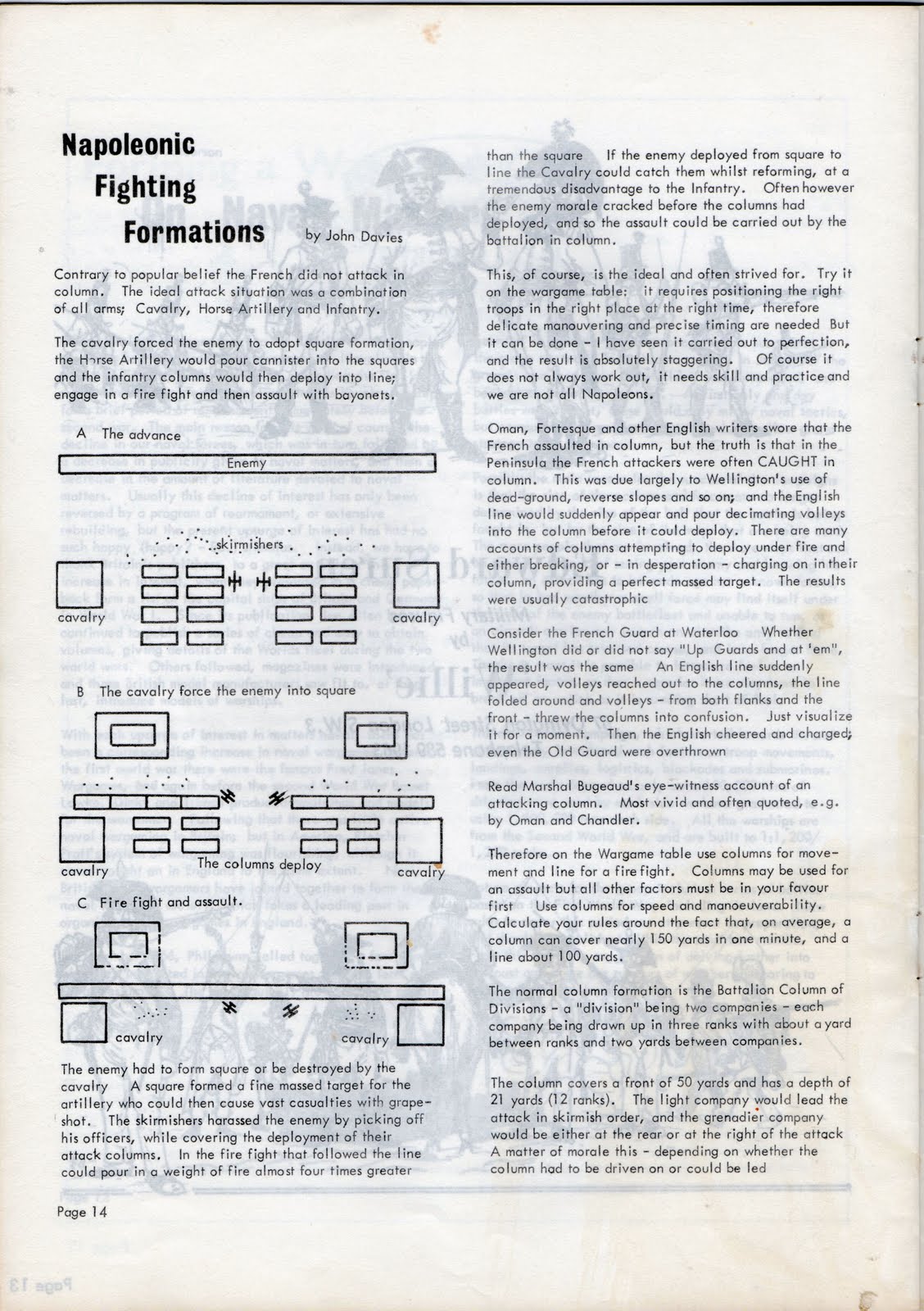
By request #1: Napoleonic Fighting Formations by John Davis, Miniature Warfare Vol 1 no 1 February 1968
This and the following three posts have been made in response to a request from Chris, who was looking for specific articles from early issues of Miniature Warfare.




Saturday, 12 February 2011
Wargaming is the craze...
by Gary L. Bloomfield, from the Veterans of Foreign Wars of the USA Magazine, February 1995.


Sunday, 30 January 2011
Operation Sealion - 'Dad's Army', by Terry Wise, Airfix Magazine August 1975
Watching the cricket match episode of Dad's Army today (the one with Fred Truman) reminded me I hadn't posted Terry Wise's Operation Sealion article on the Home Guard, so here it is.


Tuesday, 25 January 2011
Wargaming in Australia


Two more undated articles, the second is from around but after 1971. I don't know which publications they are from.
I apologise for the scans being in two parts - until and unless I get an A3 scanner this is the best I can do.
Thursday, 20 January 2011
Wellington unveiled

M S Foy's and Anonymous's comments on the Waterloo refight at the Duke of York Barracks (below, here) have made the connection with another photograph and caption - the top-of-the-headless Wellington is almost certainly Eric Knowles (before his Antiques Roadshow fame - another lame cultural reference unintelligible to those outside the UK). Thanks Tony and Anon.
Waterloo refought 3: The RAF


Third and final instalment on a theme, this time from the Cambridge Evening News of Saturday 13 1972.
I think one line of the article may have been lost (at the crease) in the scans - hope you can fill the sense in if so. I am particularly glad to see the reference to the dangers of tie wearing - please see Tony Bath post below.
Monday, 17 January 2011
Wargaming in the Twin Cities, 1966 - take 2
David Wesely, one of the subjects of the 1966 article posted below, has been in touch. This has proved one of the most widely read posts on this blog and provoked a flurry of comments, new readers, and followers. I thought people might be interested in what David said:
A friend sent me to look at your site tonite. I was amazed to see the
Wargaming in the Twin Cities, 1966 picture, which I immediately
recognized because I have a copy on the wall in my office. My copy is
in much better shape than the one you have; but then I am the guy in
the yellow-shouldered sweater! I also still have most of the Scruby
figures seen on the table, which went on to serve in many more battles.
Some of the figures should be Hinton Hunt (though I cannot spot them in
the pictures) and some are very early work from GHQ (before they
invented the first 1:285 scale microarmor). Looking at the picture
takes me back. Most of the gamers went on the many more battles too,
notably Dave Arneson (in green at the far end of the table). And the
table (with the same scenery, but laid out differently) became the site
of the first Role Playing Game, Braunstein.
Thanks for getting in touch David, and for the extra information.
A friend sent me to look at your site tonite. I was amazed to see the
Wargaming in the Twin Cities, 1966 picture, which I immediately
recognized because I have a copy on the wall in my office. My copy is
in much better shape than the one you have; but then I am the guy in
the yellow-shouldered sweater! I also still have most of the Scruby
figures seen on the table, which went on to serve in many more battles.
Some of the figures should be Hinton Hunt (though I cannot spot them in
the pictures) and some are very early work from GHQ (before they
invented the first 1:285 scale microarmor). Looking at the picture
takes me back. Most of the gamers went on the many more battles too,
notably Dave Arneson (in green at the far end of the table). And the
table (with the same scenery, but laid out differently) became the site
of the first Role Playing Game, Braunstein.
Thanks for getting in touch David, and for the extra information.
Saturday, 15 January 2011
Waterloo refought 2: Tony Bath

Another Don Featherstone photograph, again undated, and captioned "Wellington and Napoleon at the start of a reconstructed Battle of Waterloo".Napoleon is Tony Bath, while not only has the photograph cut off the top of Wellington's head, I can't read his badge either. If anyone knows when and where this was, and who was Wellington, please comment.
Good to see wargaming in ties, though Tony Bath has sensibly tucked his in with a cardigan to avoid any unintended trooop movements.
Waterloo refought 1: Don Featherstone

I don't have a date or attribution for this cutting - I think it is from the Southampton Echo, and possibly from the 1970s?
Saturday, 8 January 2011
Wargaming in the Twin Cities, 1966


With apologies again for the quality of the scans (given the condition of the original they are the best I could do on my scanner) here is an article and pictures from The Minneapolis Tribune Picture supplement from April 17th 1966.Although some of the print has been lost I think the sense of the article is still there.
I imagine the figures are mainly Scrubies. Also for UK readers, is this evidence of Vic Reeves collecting 54mm figures?
Wednesday, 5 January 2011
Lionel Tarr
Further to my previous posts on Lionel Tarr, here are what appear to be some original photographs of his wargame set up in his loft, for his Russo-German Campaign of 1941, and his use of an over-the-table net for dogfighting aircraft. Interesting to note the militaria - caps, gas mask, medals - hanging on the wall.
Don Featherstone's captions are shown below each photo

Blimey! Where did that company spring from? Surprise attack by Russian Guards eat of Berislavl

Kolchos 505. The first snow.

Stalingrad reconstructed by solo-gamer Lionel Tarr for his Russo-German campaign 1941.

Stalingrad South

Air-wargaming - a dogfight between aircraft suspended in an over-the-table net.
Don Featherstone's captions are shown below each photo

Blimey! Where did that company spring from? Surprise attack by Russian Guards eat of Berislavl

Kolchos 505. The first snow.

Stalingrad reconstructed by solo-gamer Lionel Tarr for his Russo-German campaign 1941.

Stalingrad South

Air-wargaming - a dogfight between aircraft suspended in an over-the-table net.
Subscribe to:
Comments (Atom)